With a multitude of prestigious dental awards to its name and five-star patient reviews to match, this is clearly no ordinary dentist, says Kirsty Welsh, now a loyal regular. Ten Dental+Facial is one of London’s most trusted cosmetic and restorative dental groups, with practices across South London, at the forefront of where clinical innovation meets modern patient care.
Advanced imaging and photography support every stage of treatment at Ten Dental+Facial, ensuring precision and predictability, while the guiding philosophy is always to enhance and preserve. Apparent from the moment you visit the clinic’s website, the site is fully onboard with the AI revolution, embracing the latest in AI technology, including a smile visualiser designed to help patients explore and refine their definition of a perfect smile.
Treatments are available in the form of general dentistry, including crowns, fillings, dental implants and hygiene, alongside orthodontics and specialist care such as root canal therapy. Cosmetic dentistry and facial aesthetics are also key areas of expertise, alongside unique treatments -the clinic is among the first in the UK to introduce advanced saliva and oral microbiome testing, linked to wider health, including cardiovascular and metabolic wellbeing.
Kirsty Welsh speaks to Dr Martin Wanendeya, renowned for advanced implant techniques balancing function with natural aesthetics about the innovations shaping dentistry and the future of smile design.
Your career has evolved from general dentistry into highly specialised implant and reconstructive work. What was the key moment for you that led you to focus exclusively on this field?
I began my career as a general dentist, then moved into more aesthetic work at a time when veneers were very popular, before progressing into implant dentistry. The key moment for me was completing a case that didn’t just improve how someone looked, but how they felt and functioned too. Seeing that transformation was fascinating, and that patient is still with me today.
Another big part of it was realising that implant and reconstructive dentistry isn’t something you learn at undergraduate level – you must commit to continued postgraduate learning. The field evolves so quickly that just when you think you’ve caught up, there’s something new to master. For me, that constant learning wasn’t daunting; it was exciting.
How has technology, biomaterials and patient expectations changed the way you work in implant dentistry?
Almost everything has changed. Biomaterials and bone reconstruction techniques have evolved dramatically. The types of implants we use today are completely different to those from around 2007–2008.
Technology has transformed how we plan and execute treatment. The tools we now have to deliver both biological and mechanical aspects of implant work simply didn’t exist before. And patient expectations have risen too. Years ago, people were grateful to have any kind of replacement tooth. Now they want something that looks beautiful, natural and immediate, sometimes faster than is realistically possible. As the profession has advanced, expectations have risen right alongside it.
You co-founded Ten Dental+Facial with a vision centred on longevity, transparency and team-led care. How has this shaped the clinic today?
Nik, my co-founder, and I have been in the same practice since 2004, so we’ve had the unique opportunity to see our work over decades. That long-term visibility really shapes how we approach every new patient.
From the beginning, we recognised the value of bringing in specialists endodontists, periodontists, orthodontists – to do the parts we shouldn’t. That made us one of the first specialist referral practices in South London.
It means patients receive truly comprehensive care, guided by a team of experts rather than one person doing everything. That collaborative approach is still central to who we are today.
Much of your work involves complex full-mouth rehabilitation. From a patient’s perspective, what is most commonly misunderstood about these transformative treatments?
People often only see the before-and-after photos. They don’t see the enormous amount of planning, thought and technical work behind them.
For a full-mouth case, I might spend two or three hours analysing possibilities before a patient even returns for their next appointment. None of that is obvious from the outside. Another unseen element is the laboratory. I don’t make the teeth, specialist technicians do. Their skill is what you ultimately see, guided by my direction.
Plus, people forget patient factors: how their body responds, how they behave during treatment, and most importantly how they maintain the work afterwards. When treatment ends for us, the journey is just beginning for them.
There’s also the reality that while implant dentistry has high success rates, nothing is 100%. Being able to manage complications is a critical part of what we do but that’s never visible in a polished Instagram post. Finally, materials matter enormously. You can buy an implant for around $20, but that comes with no science, support or research. We choose the best materials to push up success rates and lower risks, which inevitably affects cost but hugely improves outcomes.
Ten Dental is known for its photography-first diagnostics and collaborative case planning. Why is this level of planning so essential to achieving results that look natural both on camera and in real life?
The goal is to show patients what they’re going to look like before we begin – something that was almost impossible 25 years ago. We’ve gone from drawing on basic photos, to Photoshop mock-ups, to being able to digitally design teeth using AI and show patients both images and video simulations of their future smile.
This allows patients to be actively involved in shaping their outcome. It also helps us deliver something very close to what they’ve approved. Photography isn’t just for “before” shots – we compare before, planned and after images to measure how closely we delivered what we promised. That consistency gives us confidence in our results.
How does advanced imaging and diagnostics allow you to assess density earlier, and why does that make such a difference to long-term outcomes?
Years ago, dentists used 2D paper X-rays and often wouldn’t know if a surgery was possible until they’d begun – a stressful scenario for both clinician and patient. Now, with face scans, CBCT, intraoral scans, diagnostic wax-ups and AI diagnostics, we can create a virtual patient and plan everything before touching a tooth.
This digital ecosystem improves accuracy, reduces complications, shortens treatment time and makes the entire process more consistent. It also ensures the laboratory – who never meet the patient – fully understands what we’re aiming to achieve.
There’s a whole team behind each case. How does that collaboration influence the final result?
I work with several laboratories – one in North Yorkshire, one in Fulham, and one virtual designer who focuses purely on digital design. Designing teeth is complex, and having someone dedicated purely to design means they can focus on shape, nuance and detail. Beyond that, there are representatives ensuring implant parts are correct and up to date, and entire companies behind the biomaterials we use.
It truly is an army of people behind the scenes – much more than the dentist alone.
With aesthetic dentistry so visible on social media, what should patients be more sceptical of when choosing a dentist for aesthetic treatments?
Before-and-after photos are just one piece of the puzzle. Look for:
• Long-term results – 5 years on, not just 5 minutes after.
• Consistency – a track record of good outcomes, not a single great case.
• The “during” – seeing what happens underneath the final result.
• Training & experience – how long the clinician has been doing this and what qualifications they hold.
Patients should also ask to see multiple real case examples in person. A good clinician will have no issue showing them.
With so many advanced techniques available, how do you judge when innovation adds value, and when restraint, preserving what’s already there, is the wiser choice?
We always follow this rule:
• Does it make treatment better for the patient?
• Does it make it quicker, more comfortable or more affordable?
• Does it improve long-term outcomes?
New isn’t always better. Some innovations build on proven technology and are worth adopting; others are flashy but not beneficial. For example, with intraoral scanners, we waited until the technology was reliable and patient benefits were clear – then invested. Being selective has served our patients well.
You lecture internationally and mentor younger dentists. How does teaching at this level continue to shape your own clinical standards and outlook?
Teaching forces you to truly master a subject – knowing something and teaching it are entirely different. You’re challenged constantly, which keeps your knowledge sharp and up to date.
Travelling to lecture also allows me to learn from top clinicians worldwide, not just on stage but in one-to-one conversations about why they do what they do. That knowledge comes straight back into the practice and is shared with the entire team. It keeps me current, curious and continually improving.
Have you noticed a shift from “perfect teeth” to more natural-looking smiles?
Absolutely and I much prefer creating natural smiles. There was a phase where everyone wanted the same overly uniform, very “American” teeth. But people have realised individuality is important: our faces, style and features are all unique.
Technology now allows us to show patients subtle vs. dramatic changes, and people often choose the more natural option once they see it. A good result is when someone looks refreshed – not like they’ve obviously “had their teeth done.”
How do you personalise treatment and create bespoke smiles?
Every element – shape, shade and alignment- is carefully designed for the individual. One patient recently showed me a photo of his favourite footballer and asked if his teeth could look similar. We studied the footballer’s features, including the slight unevenness and imperfections that made the smile feel natural, and recreated something inspired by that. He was over the moon with the finished result as he now has teeth that looks like his favourite footballer.
It’s never a conveyor belt. Nothing is copied and pasted. Every smile is designed from scratch for that person’s face and personality.
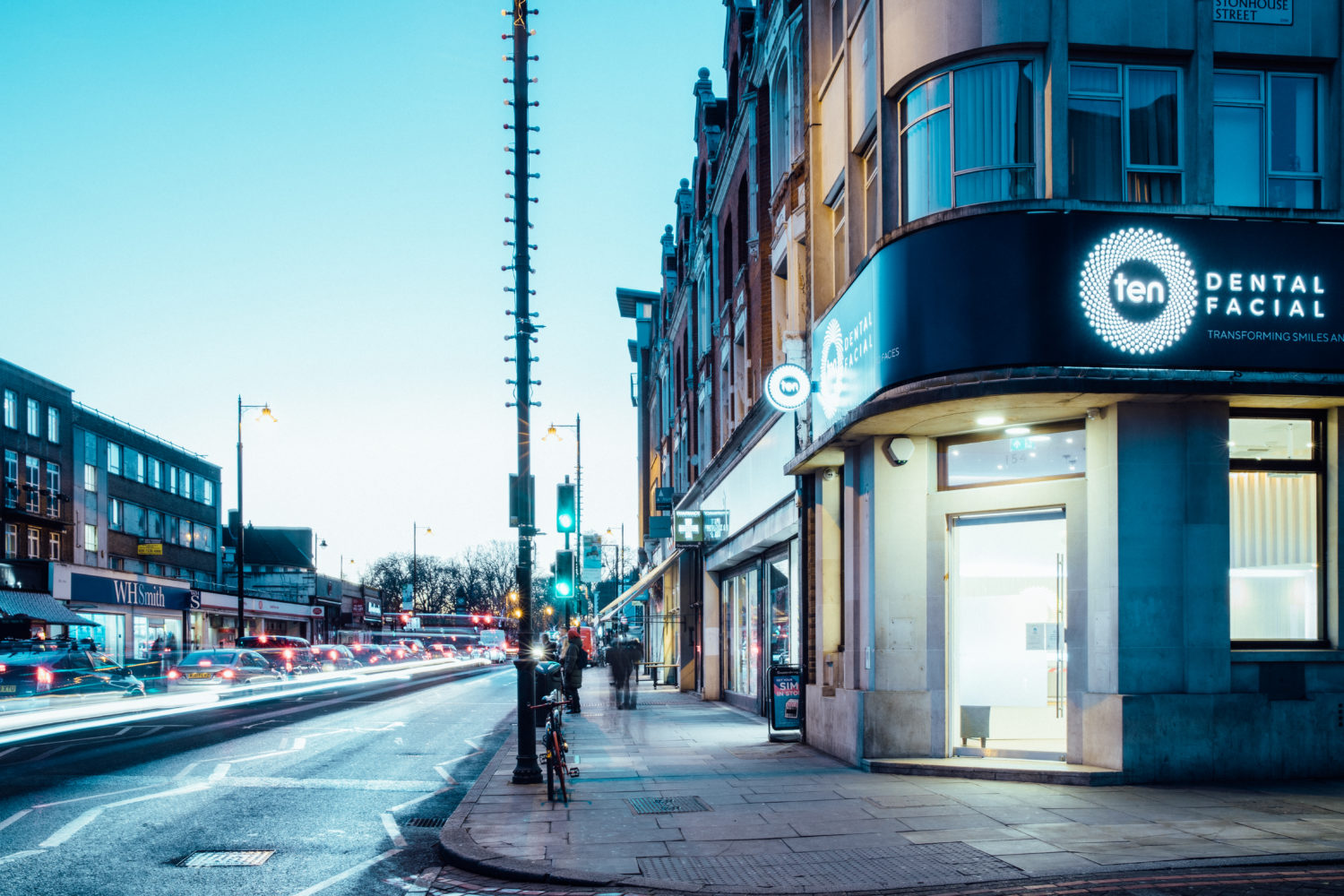
Ten Dental+Facial Clapham 154 Clapham High St, London SW4 7UQ
Ten Dental+Facial Balham 156 Balham High Rd, London SW12 9BN