Greece is one of the few destinations in the world where the sea is not a backdrop — it is the main infrastructure. Ferries replace buses, anchorages replace hotel car parks, and the distance between two islands can be covered in a morning sail. Whether you arrive in Athens, fly into Heraklion, or land directly on one of the smaller islands, a Greek summer has more formats than most travellers explore in a single trip. The six options below are a useful starting point: one on the water, five on land.
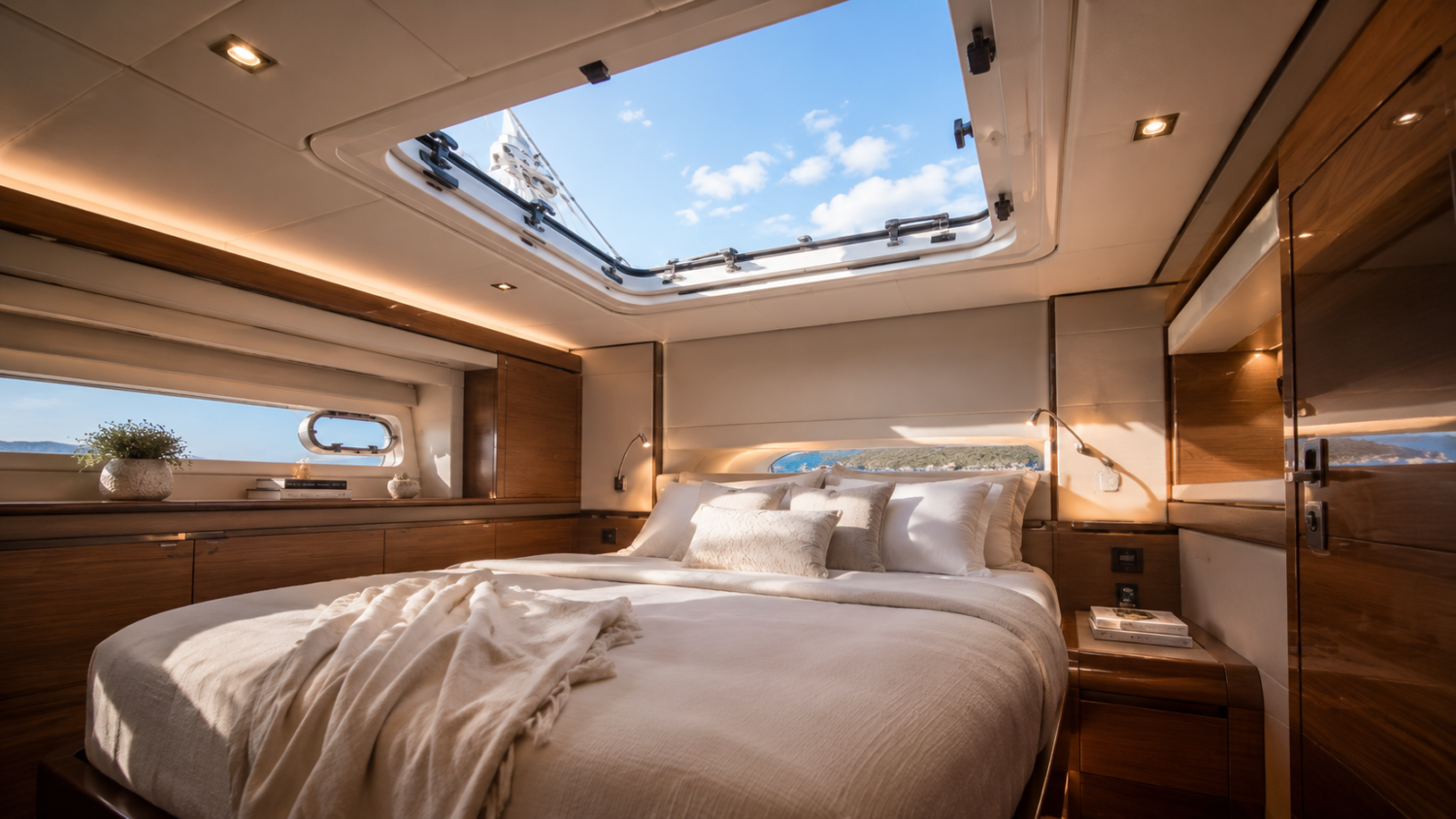
1. Yacht Charter in Greece
Greece has more than 6,000 islands and islets and a coastline that runs to roughly 16,000 kilometres. For sailors, this translates into a season that starts in April and runs to October, with a fleet spread across more bases than any other country in the Mediterranean. The main departure ports divide broadly by region: Alimos Marina and Lavrion in Attica serve the Saronic Gulf and the Cyclades; Lefkada and Preveza are the gateways to the Ionian; Kos Marina and Rhodes cover the Dodecanese.
Routing depends on the region. The Saronic Gulf is the most accessible: Aegina, Poros, Hydra, and Spetses form a compact loop that fits comfortably into seven days and suits crews making their first Greek sailing trip. The Ionian is generally calmer than the Aegean, with lighter winds and quieter anchorages — Lefkada, Kefalonia, Ithaca, and Zakynthos each have distinct character and are close enough to visit in combination. The Cyclades are the most demanding, partly because of the meltemi — the northerly wind that builds through July and August and can run above 25 knots on exposed passages. Experienced crews tend to plan Cycladic routes with the meltemi in mind, travelling early in the morning before the wind rises and choosing anchorages sheltered from the north.
Season and booking lead time both matter. Peak weeks in late July and the first half of August fill up months in advance, particularly for catamarans and larger monohulls. A booking window of six to eight months is sensible if you have fixed travel dates. If you need to compare available models across regions and dates, the booking platform for a yacht charter in Greece lists current availability.
2. The Food: From Psarotavernas to Mezedopolia
Greek food varies more by region than most visitors expect, and a summer trip is a reasonable excuse to let the eating drive some of the planning. The psarotaverna — a fish taverna, usually near a working harbour — is the baseline: fresh catch, olive oil, lemon, and grilled octopus dried on a line outside the door. Quality tracks proximity to the boats; the further from any fishing port, the less reliable the menu.
Beyond fish, the geography shapes the plate. In the Ionian, look for sofrito (veal in white wine and garlic sauce, Corfu’s signature dish), bourdeto (a spiced fish stew from the same island), and the Kefalonian meat pie kreatopita. In the Cyclades the food is plainer — grilled fish, loukoumades at island festivals, and louza (wind-cured pork) in Mykonos and Tinos. On Crete, the island that most rewards slow food exploration, the Cretan diet is still close to its original form: horta, dakos, local olive oil with a peppery bite, and lamb slow-cooked with greens.
A useful principle: eat where the menus are handwritten and change daily. A printed laminated card with photographs is a reliable marker that the kitchen is not the point.
3. Hiking the Greek Terrain
Greece is a mountainous country, and the trails above the coast offer a counterpoint to the heat at sea level. Mount Olympus in northern Greece is the obvious ambition: the highest peak in the country at 2,917 metres, with a well-maintained trail network and a mountain hut system that allows a two-day summit circuit for experienced hikers. Trailheads at Litochoro are the standard starting point.
In the islands, the terrain is more compressed. Mount Ainos in Kefalonia is the highest point in the Ionian, covered in dense Greek fir forest and wild horses, with summit views across to the Peloponnese. Mount Zas in Naxos is the highest peak in the Cyclades and a straightforward half-day hike from the village of Filoti. On Crete, the Samaria Gorge in the White Mountains runs 16 kilometres from the Omalos plateau to the Libyan Sea and remains one of the longest gorges in Europe — the descent takes four to six hours depending on pace.
Timing matters across all these routes. The window between late June and early September concentrates heat, crowds, and water scarcity on the same trail. Carry more water than seems reasonable and start before 08:00 wherever possible.
4. Cultural Sightseeing: Archaeology and Living History
The density of significant ancient sites in Greece is difficult to process on a first visit. The Acropolis of Athens requires an early slot — the 08:00 entry is worth booking two to three weeks in advance in summer — and rewards the extra effort needed to also see the South Slope, where the Theatre of Dionysus and the Odeon of Herodes Atticus sit largely unnoticed below the main rock. The National Archaeological Museum in Athens is a separate day, not an afterthought.
Outside of Athens, the sites spread across the mainland and the islands in ways that can be worked into almost any itinerary. Delphi is three hours from Athens and sits on a hillside above the Gulf of Corinth at an elevation that makes it bearable even in July. Epidaurus in the Peloponnese has the best-preserved ancient theatre in Greece and acoustics worth testing with a clap from the upper rows. Akrotiri on Santorini is a Bronze Age Minoan settlement preserved under volcanic ash — smaller than Pompeii but, in terms of painted walls and urban planning, just as striking.
On the islands, Byzantine and Venetian layers sit on top of the ancient ones. The Palace of the Grand Master in Rhodes Old Town, the Venetian harbour of Heraklion, and the fortified port towns of the Ionian each tell a different chapter of the same story.
5. Beach Time: What to Expect by Region
Greek beaches divide broadly by geology. The Ionian coast tends to sand and fine pebbles, sheltered bays, and calm water suited to swimming from the shore. The Cyclades — Paros, Milos, Naxos — offer white-pebble coves and turquoise water but also the meltemi to contend with; south-facing beaches are usually calmer in the afternoons when the wind is up. Crete has the widest range: the long sandy stretches of the north coast at Elafonissi and Balos in the west, and quieter pebble beaches along the south coast accessible by boat or dirt road.
A practical note on crowds: the most-photographed beaches (Oia on Santorini, Navagio on Zakynthos, Myrtos on Kefalonia) are busiest between 11:00 and 16:00 when the day-trip boats arrive. Arriving before 09:00 or anchoring offshore and swimming to the beach by dinghy removes most of the congestion. Navagio, the famous shipwreck beach, is accessible only by boat and has no shade — plan for a short stop rather than a full day.
6. Island Hopping
For travellers who are not sailing, the Greek ferry network is the practical backbone of any multi-island itinerary. High-speed ferries connect Piraeus to the Cyclades (Paros in 2.5 hours, Santorini in 4.5 hours on fast routes), and conventional ferries offer slower crossings with car transport. The Ionian islands are served from Patras, Kyllini, and Igoumenitsa on the mainland, with connections across to Italy for travellers with more time.
Booking two to three weeks ahead is sensible for August departures, especially for cabins and vehicle spaces. Seat-only tickets are usually available closer to departure but standing on an overnight crossing in peak season is uncomfortable. The inter-island connections within the Cyclades — Paros to Naxos, Naxos to Amorgos, Milos to Folegandros — are typically covered by smaller local ferries and can sometimes be booked only a day or two in advance.
A useful middle path is to take the ferry to a single base island and explore the surrounding archipelago by boat from there —renting a boat in Corfu opens up Paxos, Antipaxos, and the quieter Albanian coast within easy day-sail range, while choosing to hire a boat in Rhodes gives you access to Symi, Halki, and the smaller Dodecanese islands that ferries reach only a few times a week. A combined sailing-and-ferry itinerary is also a reasonable option for groups with mixed preferences: one part of the group sails, another travels between islands by ferry, and both regroup at a harbour restaurant in the evenings.