‘Artempo: Where Time Becomes Art’ – Axel Vervoordt
To walk through Bayerischer Hof is to move through successive chapters of Munich’s cultural and architectural history, where medieval vaults, nineteenth-century grandeur, post-war resilience and contemporary design coexist within a single address.
Hotel Bayerischer Hof is a living landmark at the heart of Munich. Occupying an entire city block in the Old Town, it has stood at the centre of Bavarian society for nearly two centuries. The name translates to “Bavarian Court” and remains one of Munich’s most storied addresses, instantly recognisable by its stately cream façade and distinctive blue entrance canopy — a subtle nod to the Bavarian flag.
Today, Bayerischer Hof continues to shape the city’s cultural and political landscape, hosting events such as the Munich Security Conference, the German Film Ball and The Best Brands Gala. Despite its considerable scale, with 337 rooms and suites, multiple restaurants and bars, and extensive event spaces, the hotel retains the warmth and familiarity of a family-owned property. It is this balance between grandeur and intimacy that sets it apart.
Its greatest achievement, however, lies in the way it preserves the layers of its past. Since opening in 1841, the hotel has evolved continuously, with each era leaving its mark on the property. Nowhere is this more evident than in the Palais Keller. Originally constructed in 1443 as a salt storehouse, its medieval vaults have survived centuries of change. Converted into a Bavarian restaurant in 1972, the space was thoughtfully reimagined again in 2019, blending original stonework with 18th-century timber beams and 400-year-old paving slabs sourced from the streets of Turin.
A similar sense of continuity can be found in the Hall of Mirrors, home to the award-winning Falk’s Bar. Remarkably, the room survived the devastation of the Second World War, even as much of the surrounding building suffered extensive damage. Today, it serves as one of the hotel’s most atmospheric gathering places, where guests linger over bespoke cocktails beneath glittering historic interiors. The Bayerischer Hof Spezial, a Crémant-based signature cocktail, is a must try, perfectly mirroring the understated elegance that defines the property.
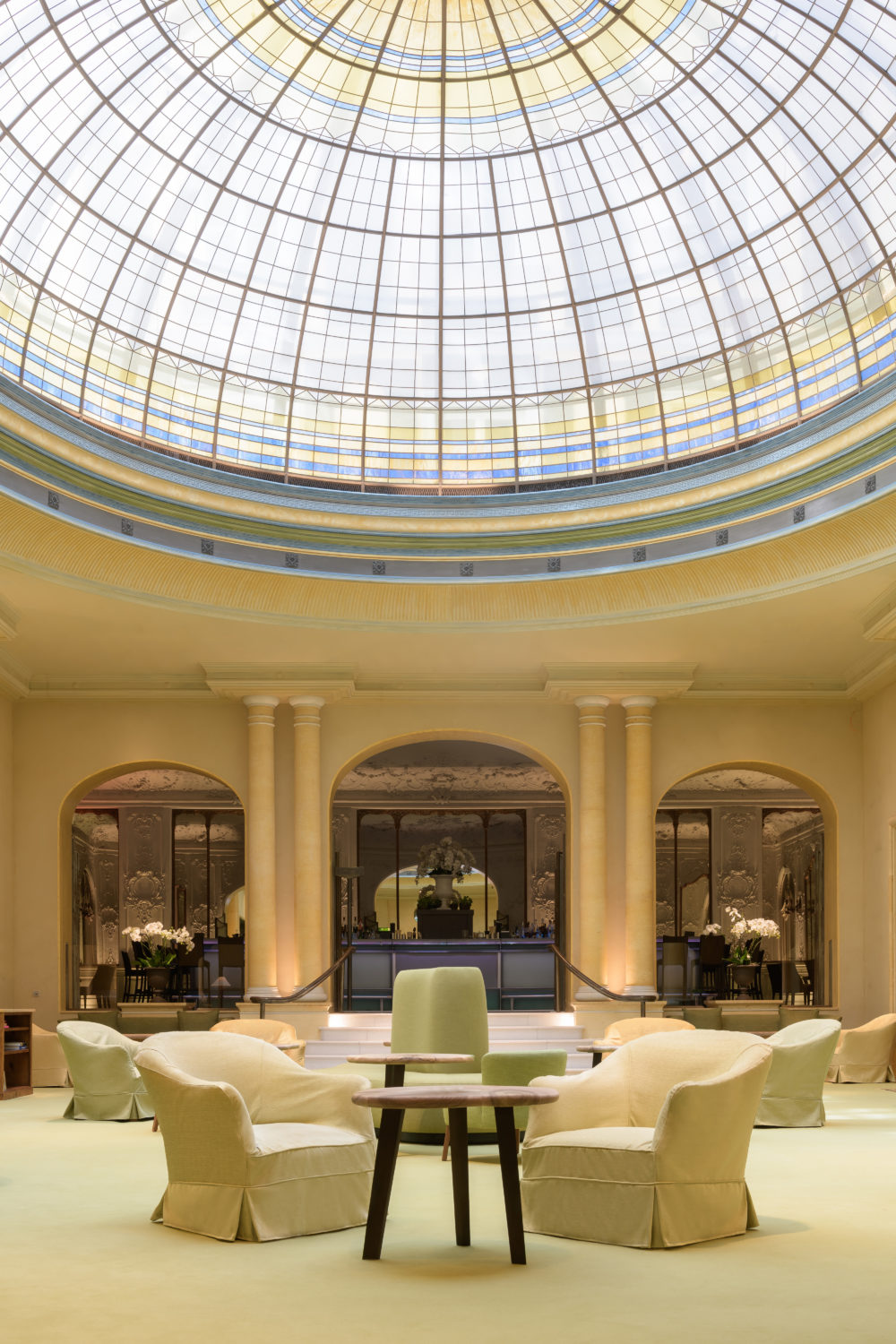
Directly opposite Falk’s Bar lies the atrium, one of the most striking additions to the hotel. Crowned by a stained-glass dome rising 8.5 metres overhead, the space feels far larger than its footprint suggests. Natural light pours through the glass canopy, illuminating the surroundings and drawing the eye upwards. The design is contemporary yet almost cathedral-like, combining theatrical scale with a sense of restraint.
The atrium flows through to the newly unveiled lobby and reception area. Warm limestone tones, marble columns and textured clay plaster evoke the sensibility of an Italian courtyard, reflecting a cultural influence that has long shaped Munich. Above, a coffered ceiling punctuated by discreet spotlights creates a subtle interplay of light and shadow.
The latest transformations bear the signature of renowned Belgian designer Alex Vervoordt. His collaboration with owner Innegrit Volkhardt began in 2009. Famously selective about commercial commissions, Vervoordt spent years resisting Volkhardt’s invitations before ultimately agreeing to contribute to what is, in many ways, the family’s home. Under the stewardship of four generations, Bayerischer Hof has remained privately owned since its founding, lending a deeply personal dimension to its ongoing evolution.
Over the past fifteen years, Vervoordt has quietly reshaped much of the property, from the historic Palais Montgelas, dating to 1811, to the Garden Restaurant, two-Michelin-starred Atelier, Cinema Lounge, Palais Hall, and the North and South Wings. His restrained aesthetic is expressed through richly textured materials, carefully considered colour palettes and a balance of elegance and practicality.
The celebrated coloured parlours, in shades of imperial yellow, emerald green, burnt umber and deep petrol blue, each possess a distinct character while remaining part of a unified whole. There is even a Mozart Parlour, where harmony and ambience are informed by the composer’s work.
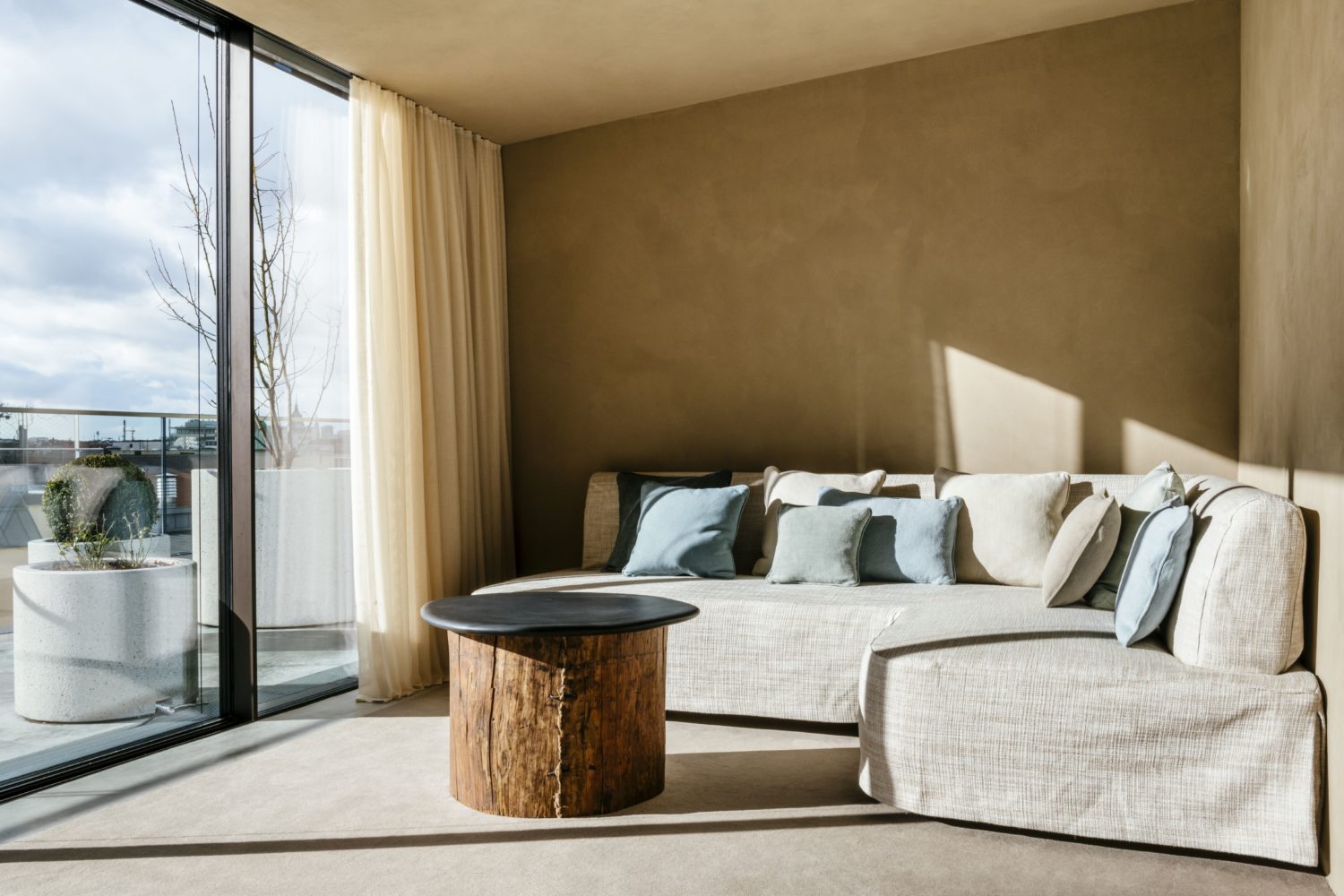
Although the redesign continues in phases, the various spaces feel remarkably cohesive. The rooms on the seventh floor are particularly striking, embracing an understated vision of contemporary luxury. Colour-blocked Valverde stone bathrooms echo the material palette introduced throughout the public spaces, while clay-plastered walls lend warmth and texture.
Upholstered beds with deep teal headboards sit against textured taupe feature walls, while a palette of charcoal, stone, beige and muted blue-green tones creates a sense of calm. Even the corridors become studies in light and shadow, drawing the eye towards carefully framed artwork at their conclusion. Long walls finished in warm, earthy tones create a cocooning effect, while concealed linear lighting along the floor edges guides movement and introduces a quiet sense of drama.
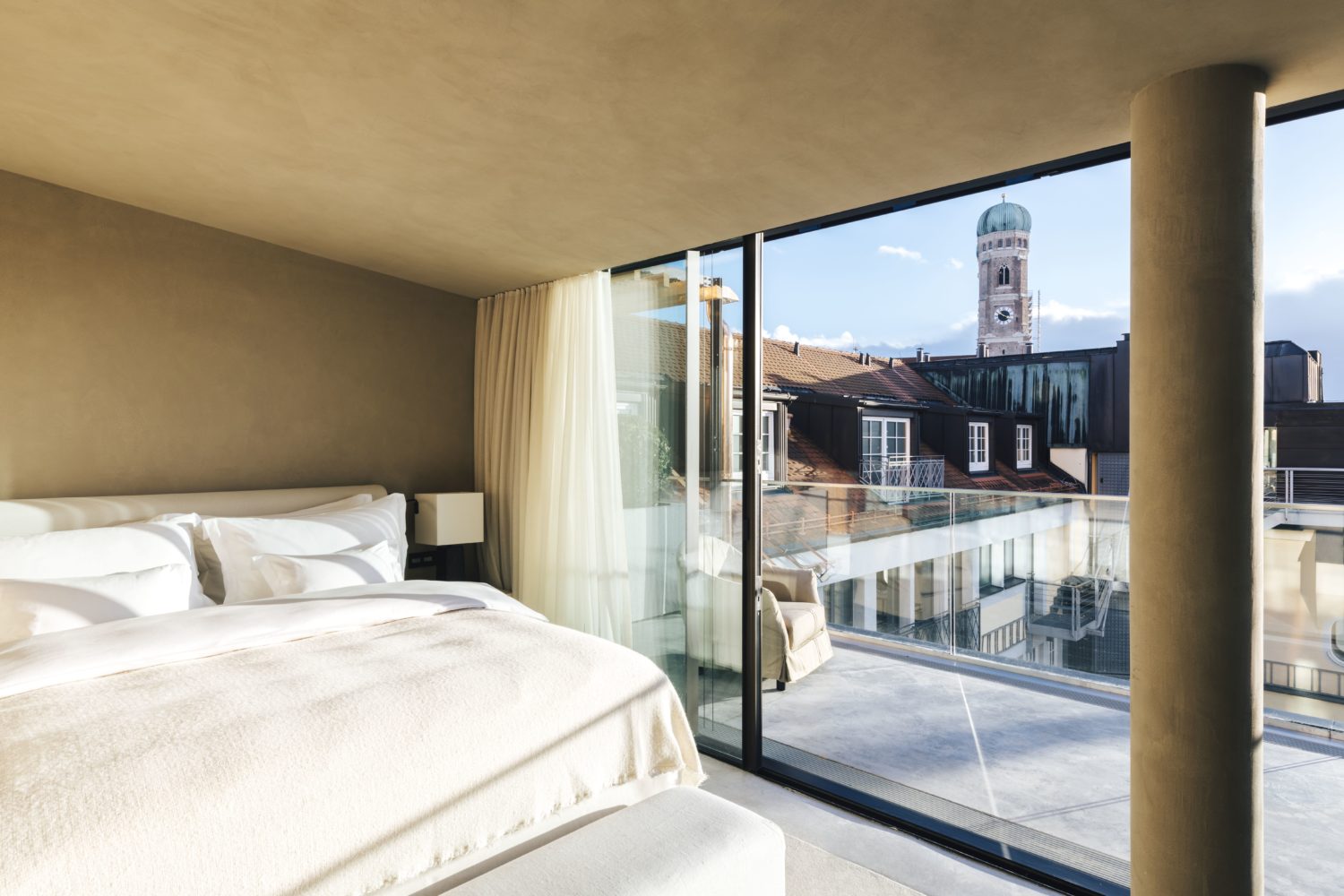
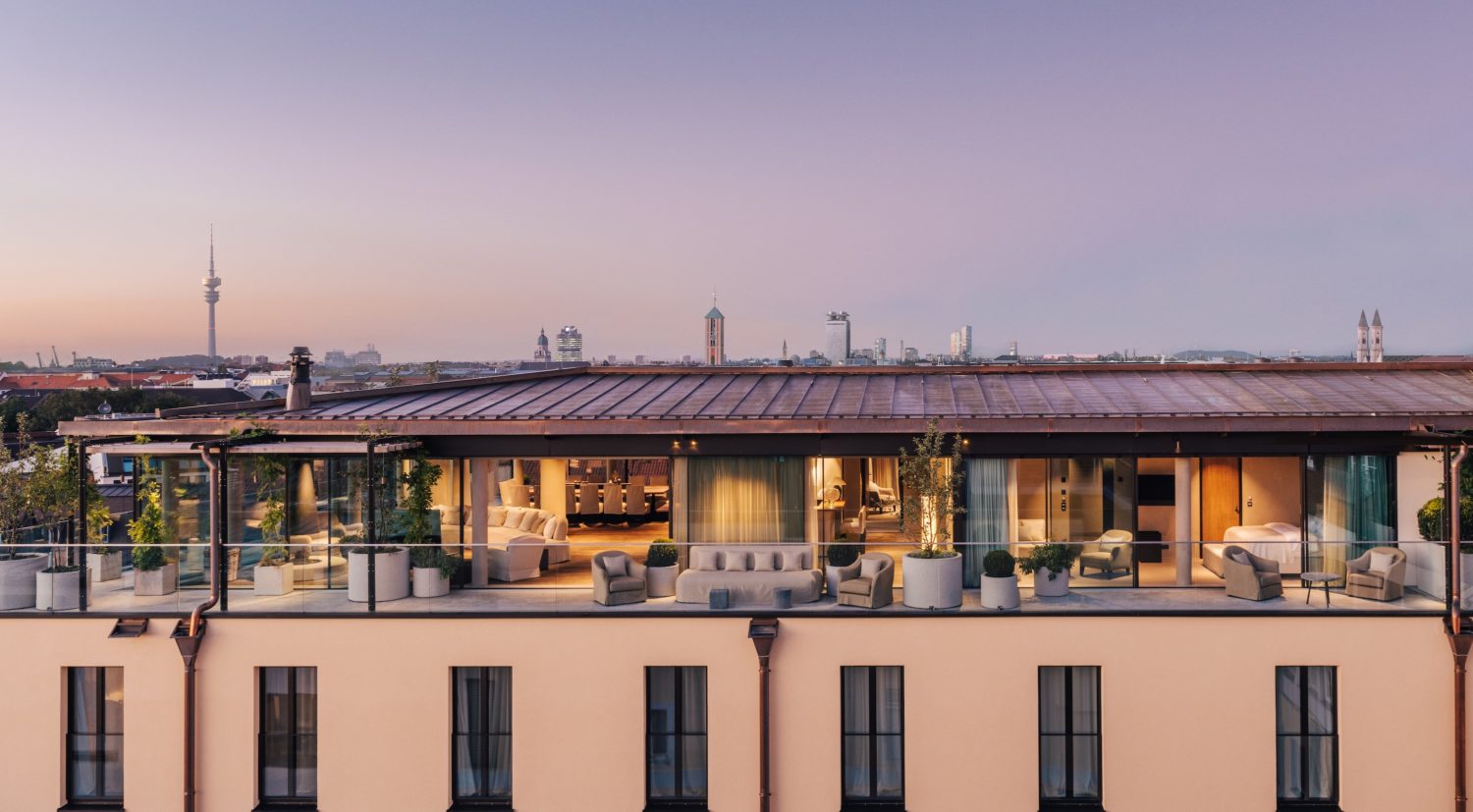
Yet alongside these contemporary expressions, classical grandeur of the Presidential Suite and the traditional Cosmopolitan deluxe rooms remain, revealing a property that seamlessly bridges aesthetics and experiences. The Bayerischer Hof encompasses a remarkable range of aesthetics and design languages, including the alpine-chic nature of Panorama Suite 7, with its dramatic attic geometry, tactile plasterwork and reclaimed timber furnishings, to the contemporary luxury of the Penthouse Garden Suite.
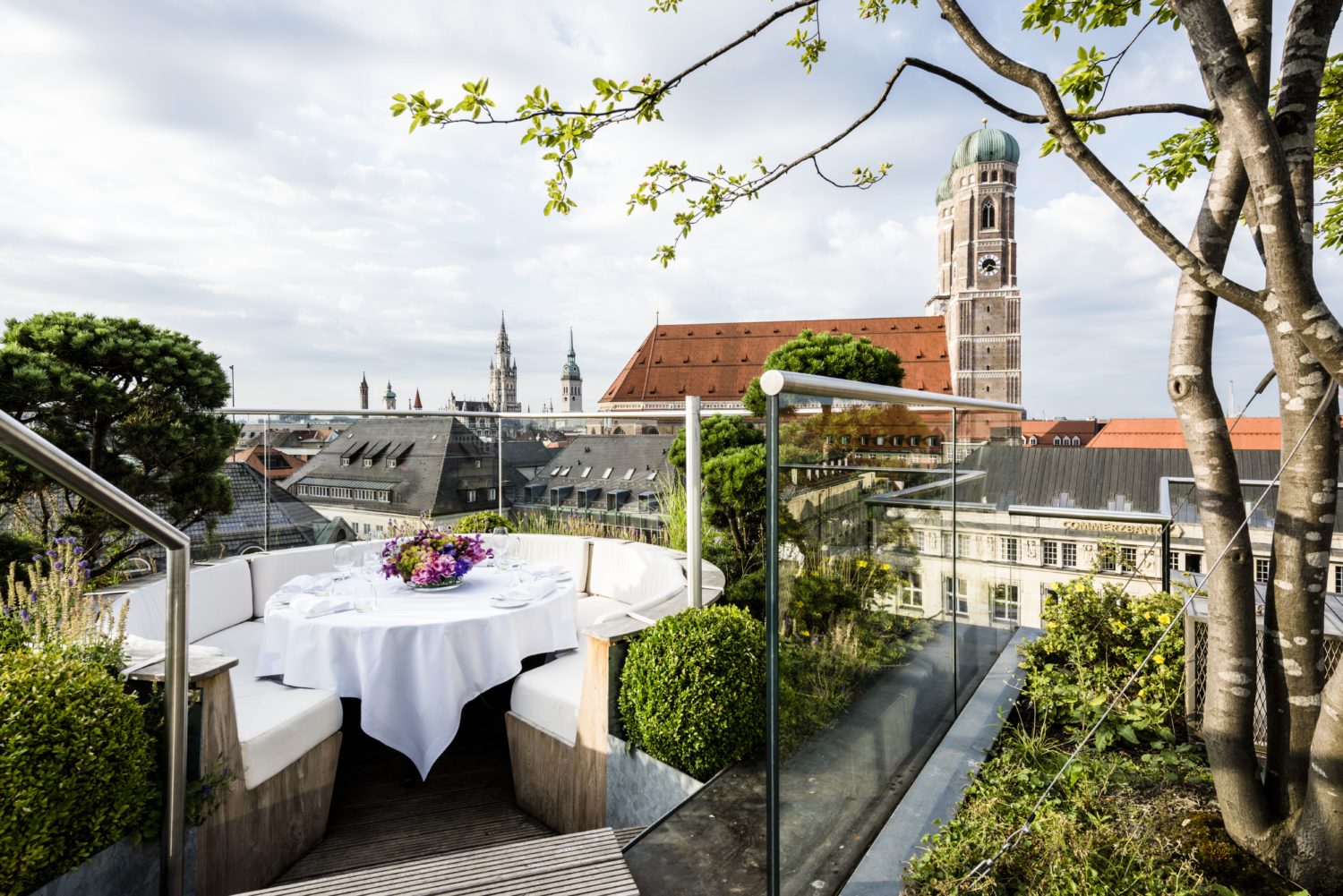
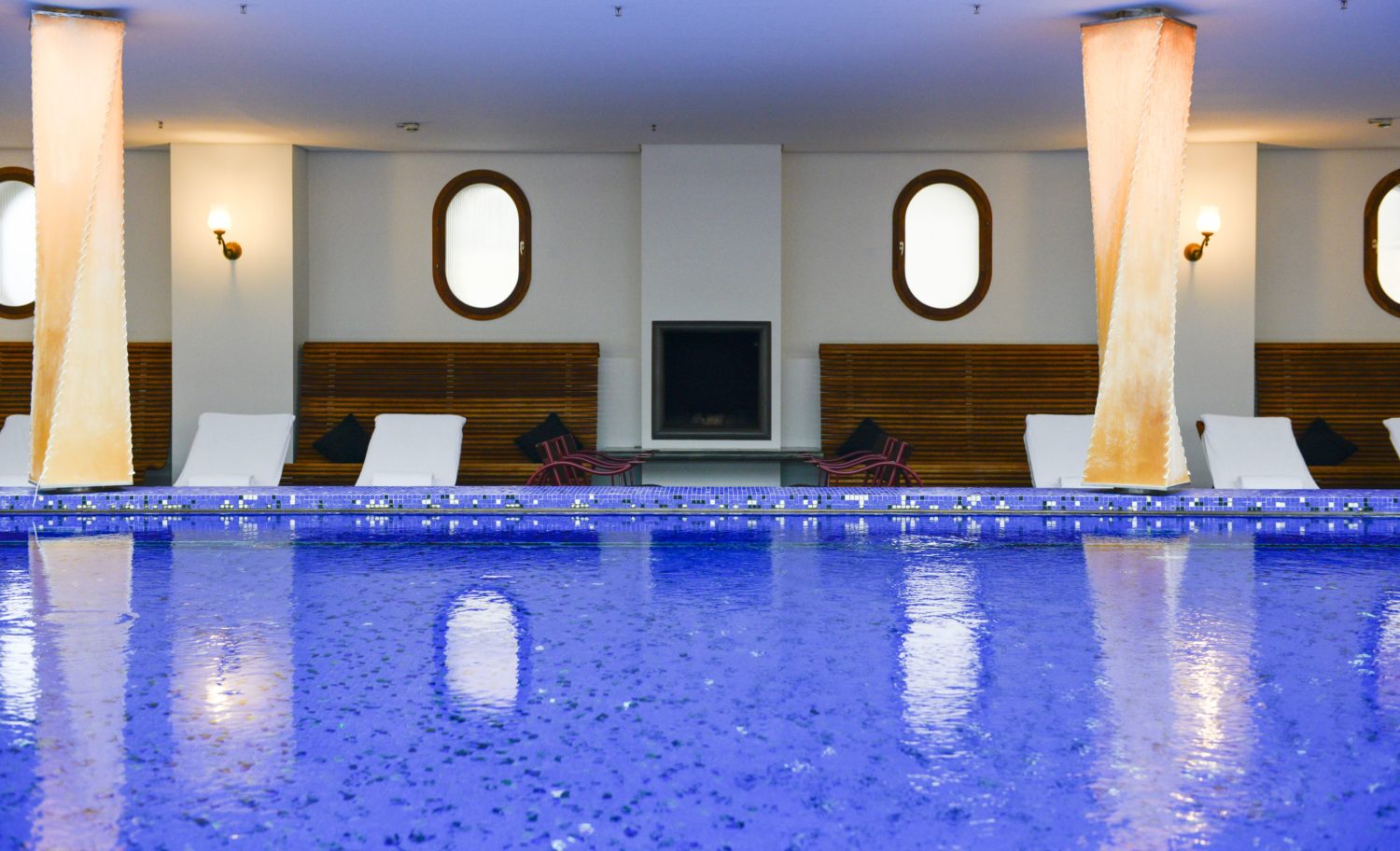
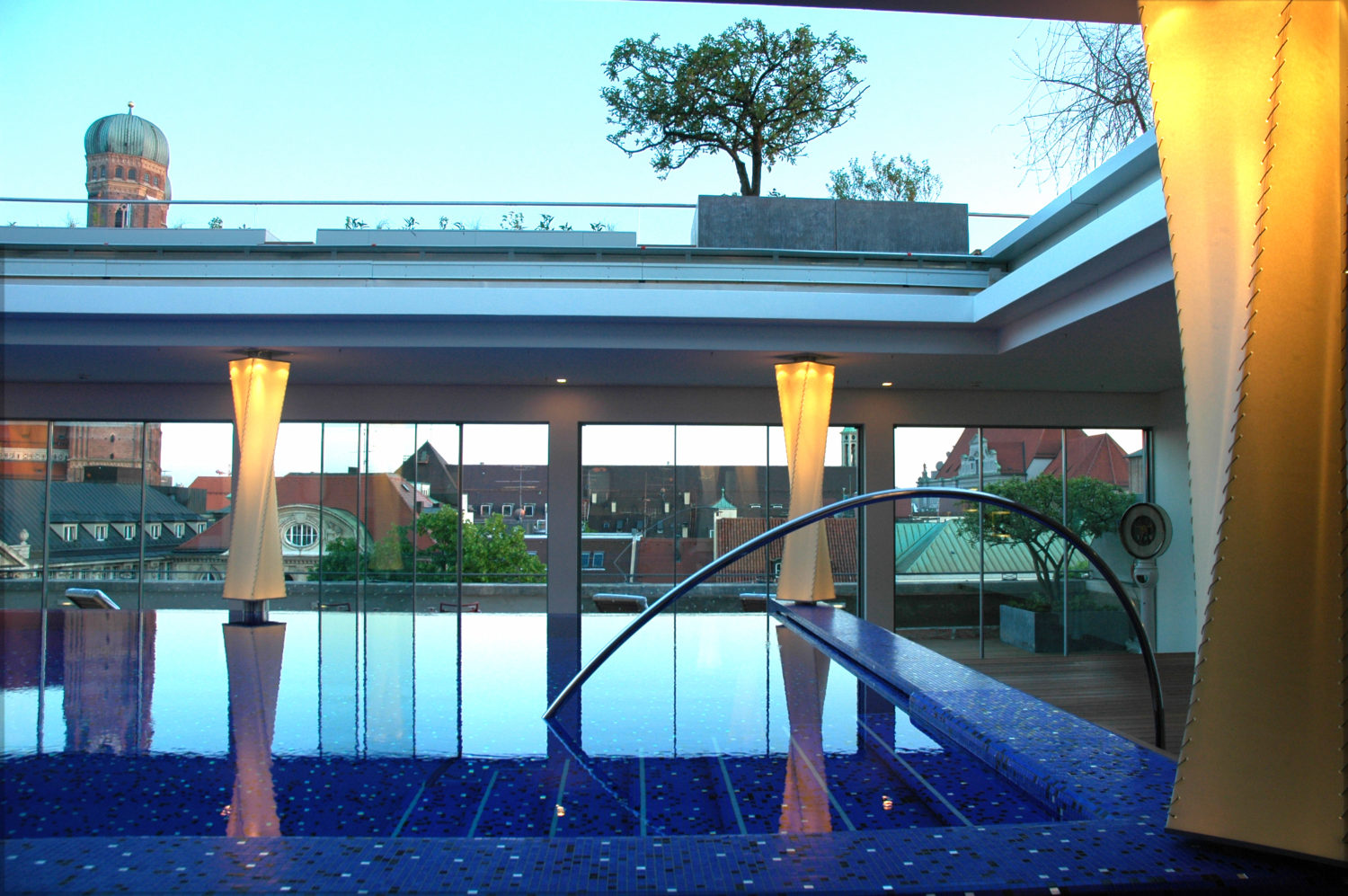
Panoramic terraces and private wellness facilities create a secluded retreat above Munich, with views extending all the way to the Alps. Elsewhere, there’s Wabi Sabi seen in room 525 and Andrée Putman’s restrained modernism featured in the Blue Spa and Lounge.
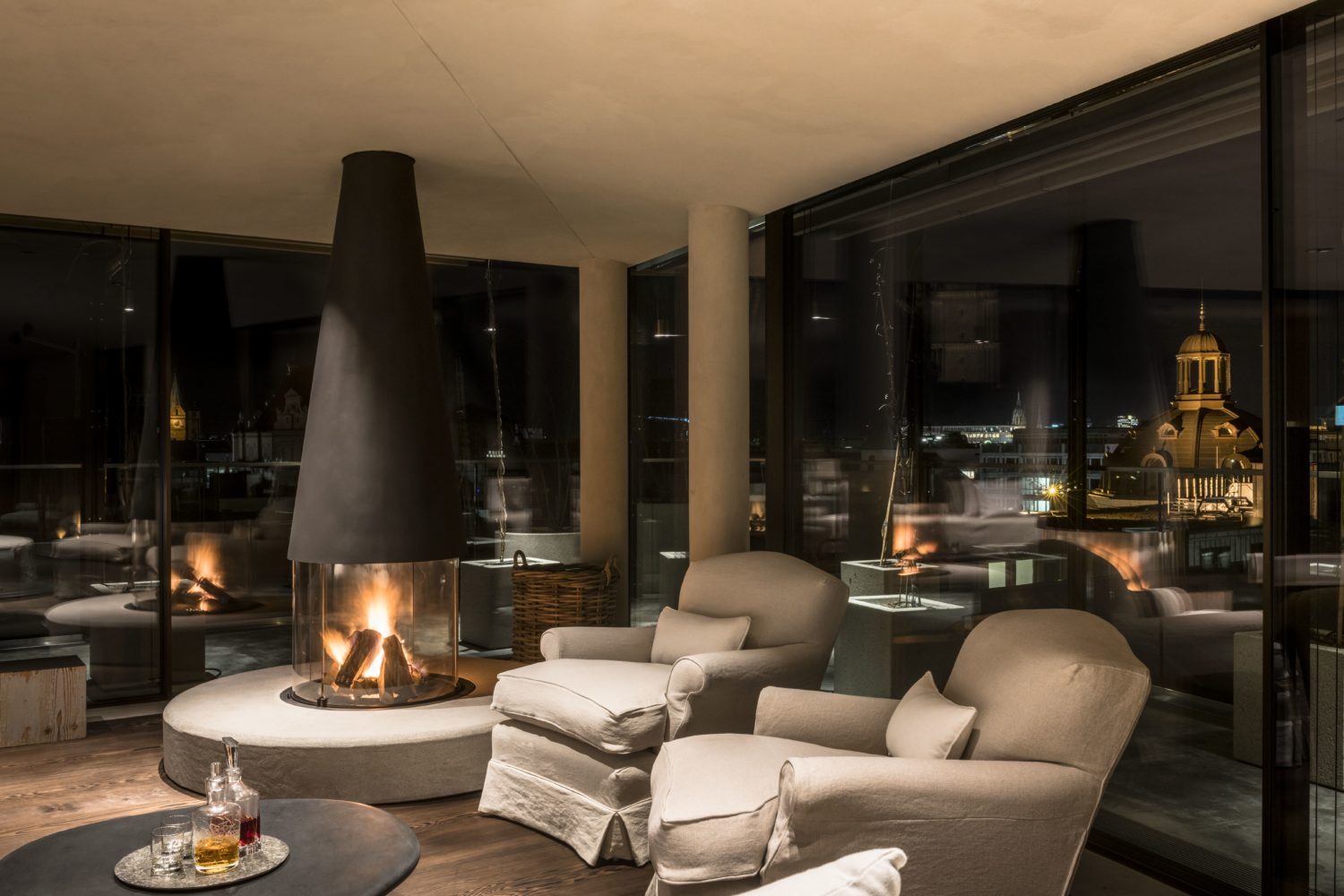
Beyond its guestrooms, Bayerischer Hof unfolds as a self-contained world. A private cinema, the dark wood-lined Night Club dating from the 1960s, the legendary Trader Vic’s, and a carefully curated collection of boutiques and ateliers create the sense of a city within a city. It leaves little reason to step beyond its doors.
Nearly two centuries after opening its doors, Bayerischer Hof continues to reinvent itself, proving that reinvention and heritage need not exist in opposition.
@bayerischerhof_munich | bayerischerhof.de/en
Promenadepl. 2-6, 80333 München, Germany